10 Turnitin Alternatives (Free & Paid Plagiarism Checkers)
The multi-billion-dollar plagiarism checker market offers dozens of choices for detecting plagiarized and AI-generated content. Given that 40% of undergraduate and 63% of graduate students admit to plagiarizing at least some of their work, these checkers have become essential tools for ensuring academic integrity.
How professors check for plagiarism varies across institutions. Many rely on Turnitin, a prominent plagiarism checker and AI detector that compares writing against a large database to highlight unoriginal text, flag missing citations, and help educators guide students toward better researching and writing habits.
However, the market offers many other tools to help educators and students ensure the originality of finished work and maintain academic integrity. This article offers a look at several Turnitin alternatives to help you find the best plagiarism checker for your specific situation.
Key Takeaways
- Turnitin is widely used but limited to institutions and lacks transparent pricing.
- Many alternatives offer better accessibility for students, educators, and professionals.
- Quetext provides an all-in-one solution with plagiarism, AI detection, and other writing assistance tools.
- Modern tools detect more than copy-paste, including paraphrased and AI-generated content.
- Grammarly prioritises surface-level writing improvements, but its plagiarism checker remains limited for serious academic or professional use.
- Copyleaks and Originality.ai often produces false positive and inconsistent results, making them less reliable for high-stakes accuracy.
- Free tools often have limits (word count, accuracy, or ads).
- Best tool depends on your use case (student, educator, marketer, or team).
Drawbacks of Turnitin
Considering an alternative to Turnitin may be necessary if you need a flexible, accessible option to detect plagiarism and AI-written content. Though the tool is a popular addition to academic workflows, Turnitin can present challenges that make it unsuitable for some educators and students.
Academic Exclusivity
Turnitin is built for academic institutions rather than individuals. Colleges and school districts that wish to provide access to its tools must contact the Turnitin sales team for package options and pricing information.
The software sales process can be lengthy, especially if multiple decision-makers are involved. Educators may find themselves waiting months before being able to use Turnitin. Not to mention, the lack of individual plans means that students can't sign up for personal Turnitin accounts to check assignments for self-plagiarism or missing citations prior to submission.
Ambiguous Pricing
Turnitin doesn't list pricing on its site. Instead, educators or the institutions where they work have to request a quote from the sales team. According to Turnitin, this approach allows sales to create a customized solution for each institution.
The only clear pricing available on Turnitin's website is in the help files, where Turnitin suggests its iThenticate product as an alternative for individuals. Instead of monthly plans, this similarity checker offers plagiarism detection for $125 per paper.
Limited Functionality
Educators who do use Turnitin need to be aware that it doesn't actually check for plagiarism. Instead, the tool looks for similarities between a given text and the sources in its database. Every instance of similarity, even properly cited quotes, is highlighted in the final report. Educators are responsible for reviewing the results to determine which highlights represent incidences of real plagiarism.
Turnitin allows users to add nuance to the plagiarism detection process with custom "exclusion rules," which may be necessary to prevent the tool from flagging common words and phrases. Turnitin also lacks the capability to check for plagiarized images like graphs or charts.
If your school already uses Turnitin, you may have your hands tied, but if you're in need of a high-quality online plagiarism checker that you can actually access, read on for some of the best alternatives to consider.

TABLE OF CONTENTS
- #1 Quetext
- #2 Grammarly
- #3 Copyscape
- #4 DupliChecker
- #5 PlagScan
- #6 Viper
- What is the best alternative to Turnitin?


10 Paid & Free Turnitin Alternatives
Every plagiarism detection tool has its pros, cons, and specific use cases. Some tools are built for educational purposes; others cater to content marketers and writers. Compare these 10 Turnitin alternatives to find the tool with the features you need to maintain academic integrity.
Quetext
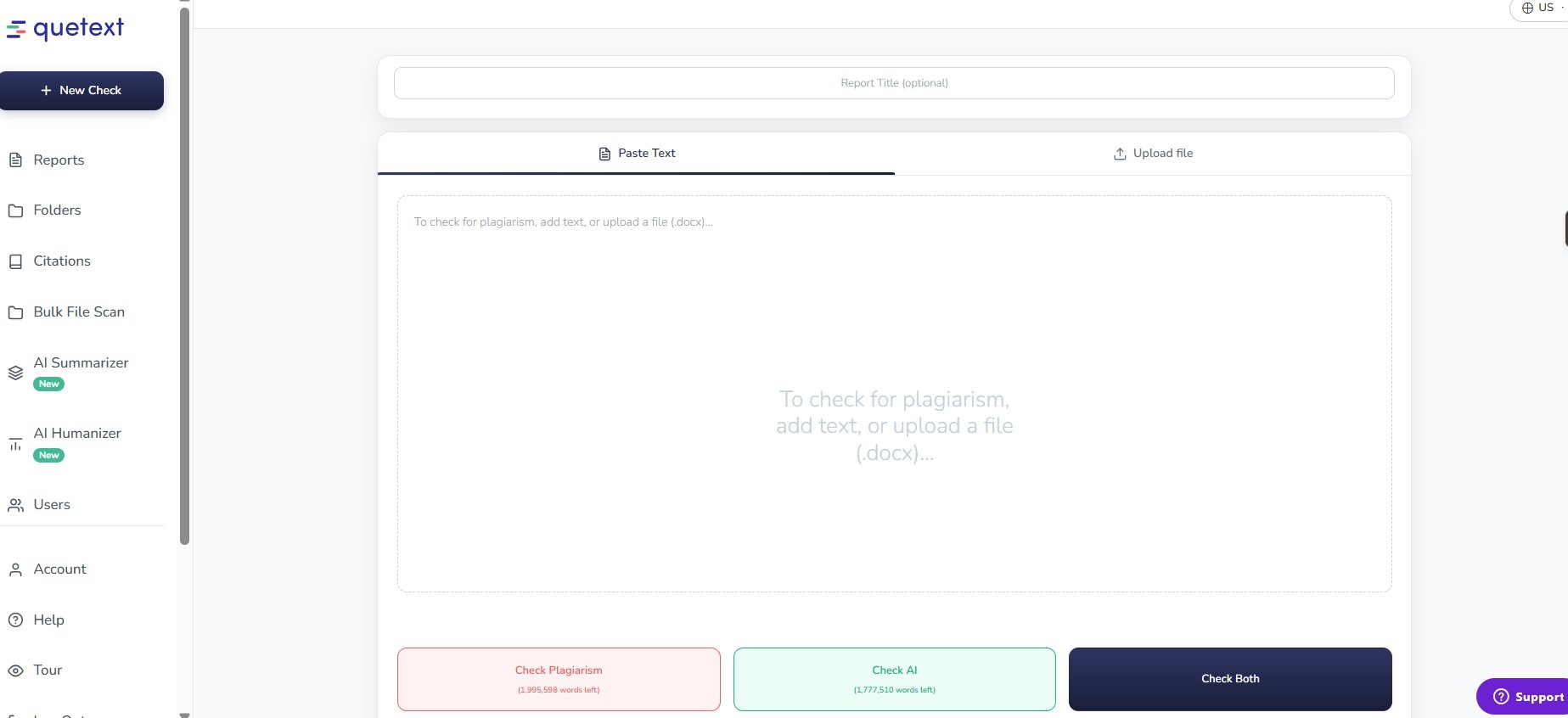
Quetext is an all-in-one content integrity and writing platform designed to help users create original, credible, and high-quality content with confidence. Its advanced plagiarism detection and AI detection tools work together to ensure content is both authentic and properly cited, without discouraging responsible AI use.
Users can access Quetext instantly through a free version or upgrade to a paid plan with no prior approval required. When unoriginal or closely matched content is detected, Quetext's built-in citation generator helps users create properly formatted citations in APA, MLA, and other styles, while flexible source-exclusion options allow each plagiarism check to be fine-tuned for accuracy.
Beyond plagiarism and AI detection, Quetext also supports the entire writing workflow with tools for summarizing, paraphrasing, grammar checking, and citation generation, making it a complete solution for students, educators, and professionals.
Pricing
Ideal for light use and first-time users:
- DeepSearch™ Plagiarism Checker (up to 1,000 words)
- AI Detector (up to 1,000 words)
- AI Summarizer (up to 2,000 words)
- Website Citation Generator
- AITutorMe Paraphrasing Tool (Upto 100 words)
- Grammar Checker
Essential Plan
Designed for individual users who need powerful, consistent writing and integrity checks.
Starting from $8.25/month
Includes:
- DeepSearch™ Plagiarism Checker (100,000 words/month)
- AI Content Detector (100,000 words/month)
- AI Summarizer (25,000 words/month)
- AITutorMe Paraphrasing Tool (25,000 words/month)
- Bulk file uploads (up to 20 files)
- Grammar & Spell Checker
Top Features
Quetext's DeepSearch™ technology goes beyond surface-level matches, while ColorGrade™ visual indicators clearly show which sections need attention, making it easier to revise content quickly and confidently.
Smart, Context-Aware MatchingQuetext analyses both wording and context, detecting plagiarism even when content has been slightly rewritten to disguise similarity.
AI Detection with TransparencyQuetext's AI detection provides sentence-level scoring, allowing users to see which specific parts of their content may appear AI-generated.
Fast, Ad-Free ExperienceQuetext is one of the fastest plagiarism checkers available, offering an ad-free interface for both free and paid users so they can focus entirely on improving their work.
Use Cases:
Verify academic integrity, assess AI usage responsibly, and support ethical writing practices.
StudentsCheck originality, summarize research, refine language, and generate citations before submitting assignments, whether for online or in-person classes.
Content Writers & BloggersEnsure articles, blogs, and scripts are original, well-written, and publish-ready.
Marketers & ProfessionalsProtect brand content, summarize reports, and maintain credibility across campaigns and client deliverables.
Grammarly
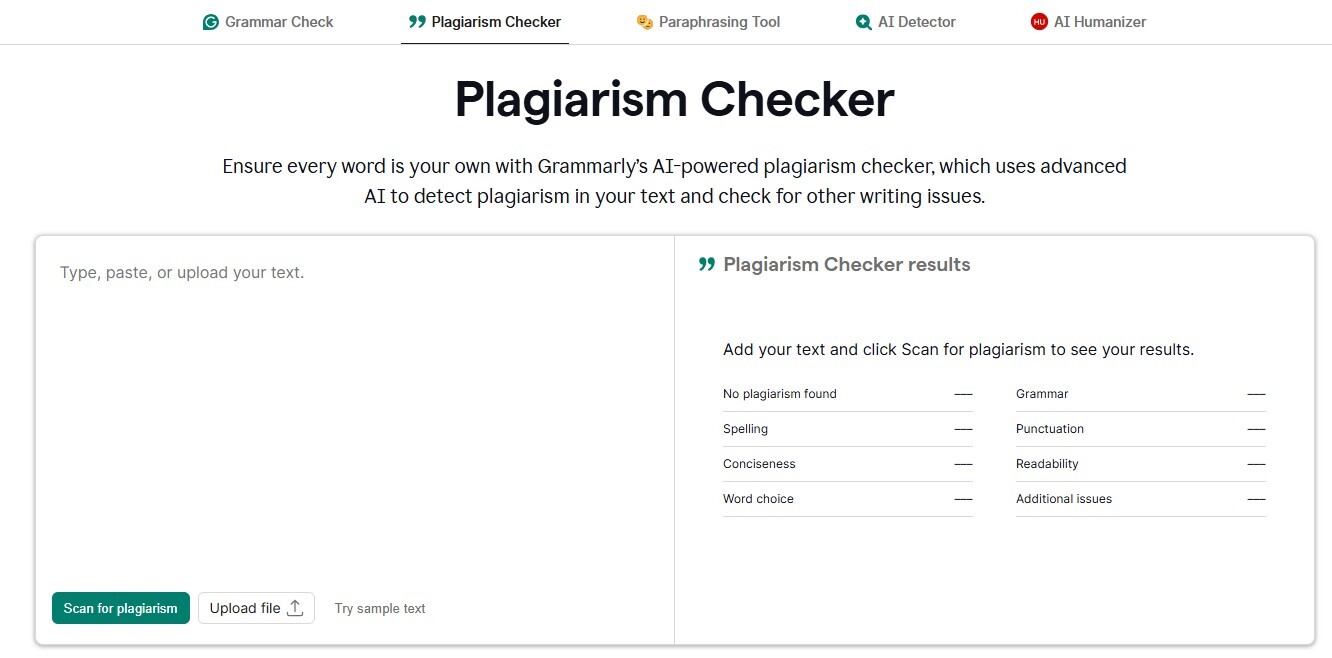
Students, educators, and other professionals most often rely on Grammarly to correct spelling, grammar, and word use, which can be helpful even at the free level. The tool also offers a plagiarism checker with a built-in AI detector if you're willing to pay for it.
Pricing
- Free: Unlimited spelling, grammar, and usage checks
- Premium: $12/month annually or $30/month monthly for all Free features, plus custom writing tone checks, sentence rewrites, and access to the plagiarism checker
- Business: $15/user/month annually or $25/user/month monthly for all Pro features, plus business-specific options like a style guide or brand tone
- Professional: Custom pricing available on request
Top Features
- Writing feedback: Grammarly provides an advanced grammar checker and offers additional feedback to help you write more clearly.
- Originality score: Grammarly provides an originality score and AI percentage to show how much of your work matches existing sources or was "likely" generated by AI.
- Chrome extension: The Grammarly Chrome extension helps you detect grammatical errors wherever you write but lacks some of the functionality of the Grammarly editor.
Use Cases:
- Business purposes: With a subscription to Grammarly's plagiarism checker, employees and supervisors can keep all communications original and free from AI content.
- Content production: Grammarly allows copywriters and entrepreneurs to ensure they create unique content that increases brand awareness.
- Easy editing: While some lag times can make the software a challenge to use, Grammarly allows paying users to edit their work as they check for originality.
Copyleaks
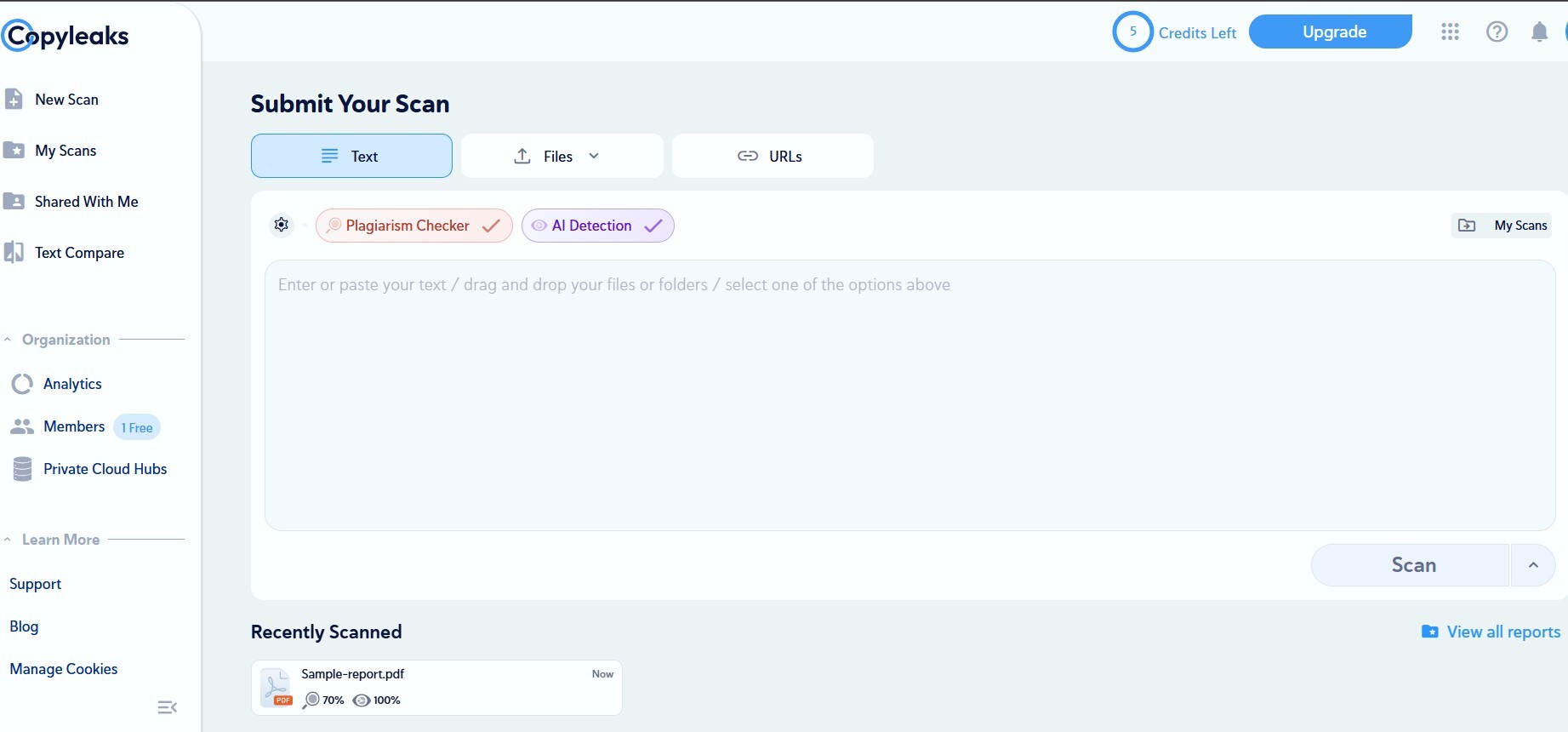
Copyleaks offers a range of tools that include a plagiarism detector, an AI detector, and a Google Chrome browser extension. Rather than looking specifically for unoriginal content, Copyleaks scans for human-written content and flags anything that doesn't follow human patterns.
Pricing
- Annual: Starting at $13.99/month for plagiarism checking and AI detection up to 1,200 credits (300,000 words)
- Monthly: Starting at $16.99/month for both detectors up to 100 credits (2,500 words)
- Additional credits: Available for an additional monthly fee (up to 30,000 for annual plans and 2,500 for monthly plans)
- Professional and Educational: Pricing available from sales team
Top Features
- Diverse detection: Copyleads can detect plagiarized and AI-generated writing, find plagiarism in images of text, highlight code created with AI, and reveal manipulated characters.
- LMS integration: Copyleaks' AI and plagiarism detection tools can be made available for teachers through several popular LMS platforms.
- Analytics: Educators can access reports that include every scan they've performed so they can track instances of plagiarism and AI content in students' work over time.
Use Cases:
- Multidisciplinary checking: Because Copyleaks can detect plagiarism in both text and code, the platform is useful for educators across departments.
- Schools and universities: The Copyleaks LMS integration gives educators and students easy access to the plagiarism checker and AI detector.
- Academic integrity: If educators can use instances of unoriginality as opportunities to teach their students better writing and research habits.
Scribbr
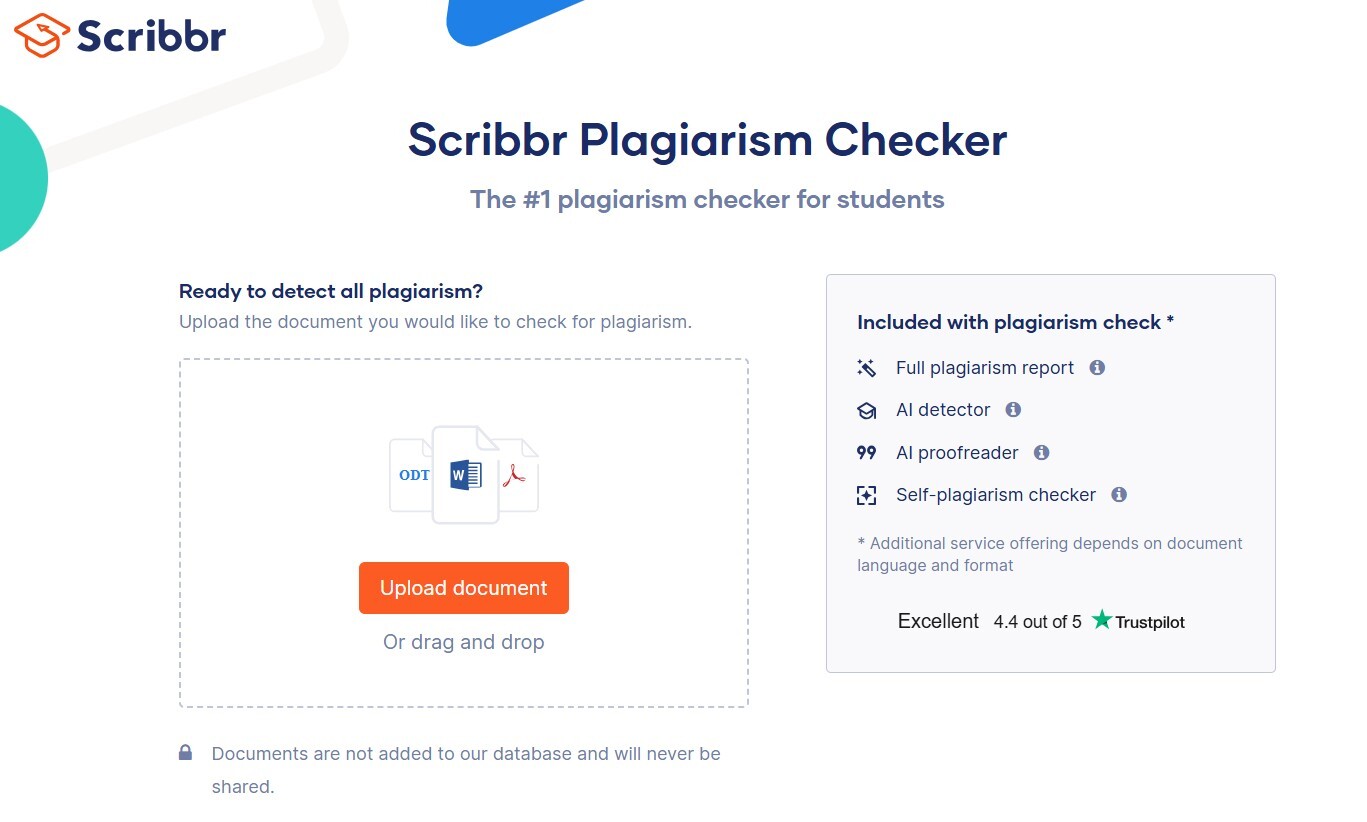
Scribbr is a plagiarism checker for students that uses Turnitin's database to assess academic essays and papers. As it scans for plagiarism, Scribbr also detects content written with AI and checks for errors in grammar and spelling. Separate professional editing services are available to help students and academics polish their work before submitting it for grading or publication.
Pricing
- Free: See a list of five sources that most closely match your work
- Premium: Priced per paper, ranging from $19.95 for up to 7,499 words to $39.95 for 50,000 or more words.
- Bulk Pricing: Available for institutions on request
- Professional Editing: Priced based on length, academic level, type of editing, and desired turnaround time
Top Features
- Proofreading: Scribbr offers both professional and AI-powered proofreading. The AI option provides a writing score with suggested edits; professionally proofread papers are returned in Word documents with tracked changes for students to review.
- Citation suggestions: Scribbr highlights missing citations and allows students to insert appropriate attribution with the platform's citation generator.
- Personalized plagiarism checking: Students can upload past work to Scribbr to check for self-plagiarism. They also have the option of uploading and checking against only the sources they used instead of Scribbr's entire database.
Use Cases:
- Improving schoolwork: High school students, undergraduates, and graduates can use Scribbr's tools to polish their work and learn better research, writing, and citation habits.
- Academic publishing: Scribbr gives graduate students and educators tools to catch accidental plagiarism, ensure proper citations, and streamline academic papers before submitting them for publication.
- One-off plagiarism checking: Since Scribbr prices its services per project instead of monthly, it can be a good option for students and academics who only need to check a few papers per year.
Copyscape
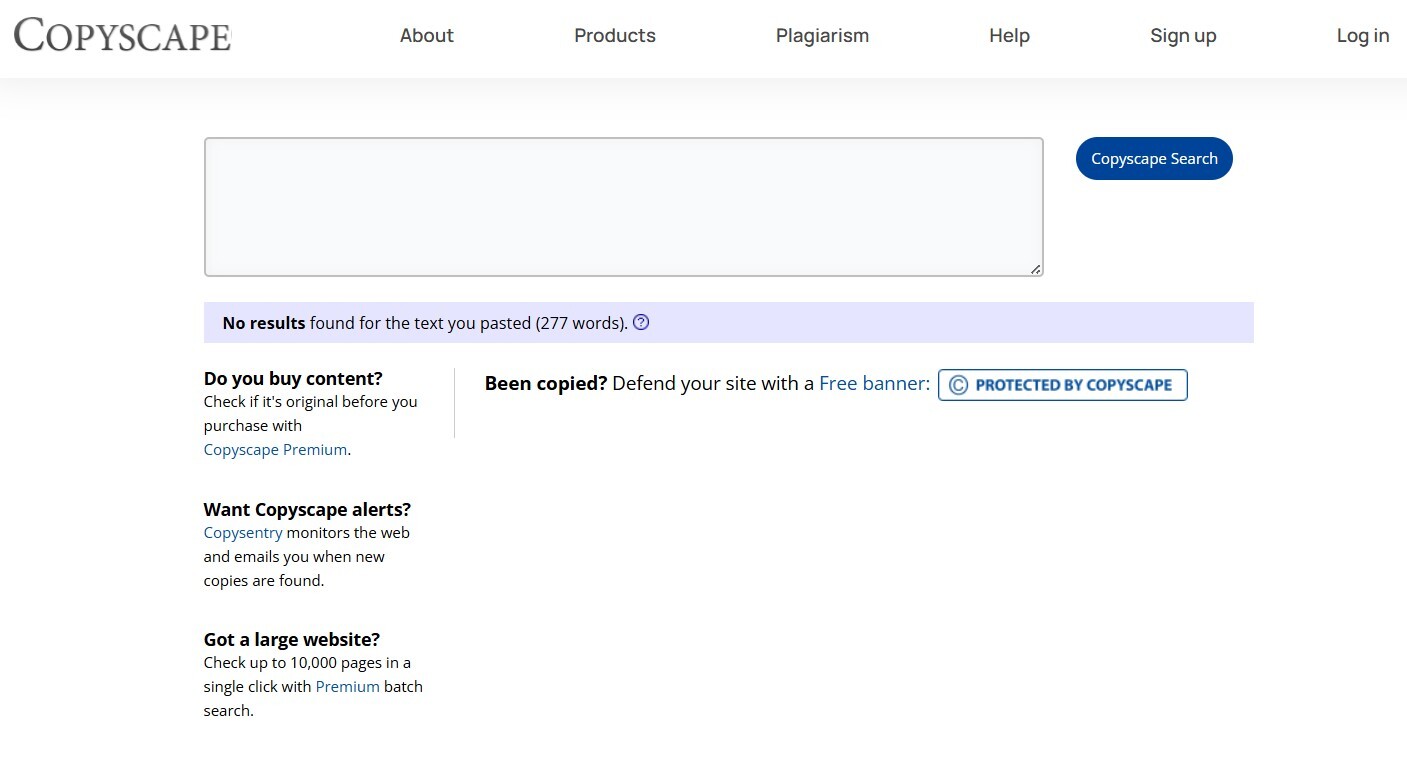
Copyscape plagiarism detection software scans your work to ensure originality, but you need to pay for Copyscape Premium to access it. The company also offers a unique product called CopySentry that helps businesses monitor the web for theft of their content. Companies can also build a private index of sources to check for duplicate content across an entire website or blog.
Pricing
- Copyscape Premium: Priced per word, starting at $0.03 for the first 200; each additional 100 words costs $0.01
- CopySentry: Starting at $4.95/month to check up to 10 website pages weekly; $19.95/month for daily checks. Up to 500 additional pages for $0.25 to $1/page
- Professional: Available for businesses from the sales team
Top Features
- Batch search: Copyscape lets you check multiple pages for plagiarism at once, which comes in handy if you need to scan large websites or collections of text.
- Exclusion list: Users can create an exclusion list that filters certain sites out of the plagiarism check (for instance, other websites they own).
- Syncs with WordPress: Copyscape Premium includes a WordPress plugin that allows users to scan for plagiarism while producing content or reviewing freelance contributions.
Use Cases:
- Blog maintenance: Copyscape‘s WordPress plugin helps content teams maintain integrity when working with outside writers by flagging instances of plagiarism directly inside the CMS.
- Monitoring competition: Copyscape’s CopySentry product enables businesses to identify competitors who may purposefully or accidentally duplicate their content.
- Business acquisitions: After one business acquires another, the content team can use Copyscape's batch search feature to audit the acquired website for plagiarism.
Originality.ai
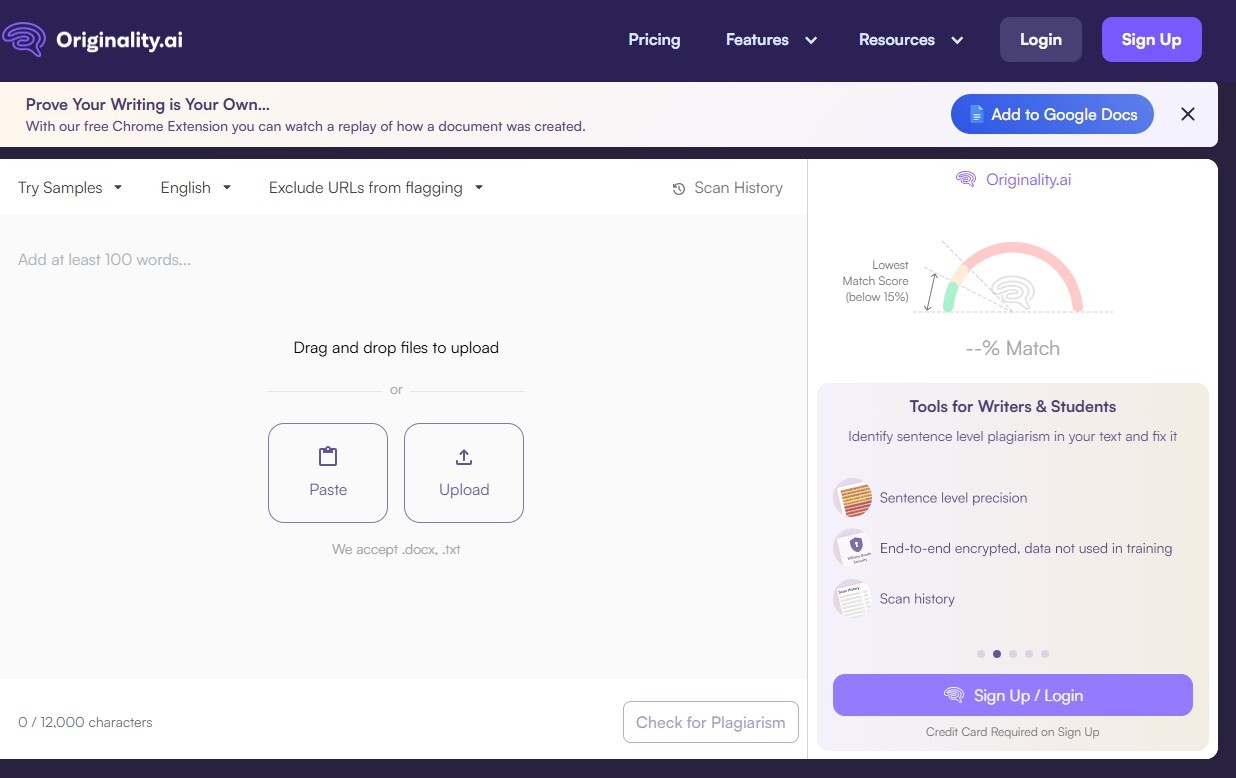
Originality.ai markets its AI detector and fact checker to content managers, writers, and publishers who want to "publish with integrity in the world of generative AI." They also provide tools for checking grammar and readability to ensure that content is understandable and flows well.
Note that the Originality.ai site states specifically that its tools aren't for students; educational institutions will need to consider a different plagiarism checker.
Pricing
- Individual: $14.95/month annually or $19.95/month monthly for up to 100,000 words
- Professional: $136.58/month annually or $179/month monthly for up to 150,000 words.
- As-needed: $60 for 60,000 words
Top Features
- Multi-functional Chrome extension: Writers can install the free Chrome extension to track the creation of their work and generate shareable originality reports. The extension allows clients to view changes and edits as they were made and easily distinguish copy-and-pasted text from original writing.
- Fact-checking: Originality.ai's fact checker uses real-time data and contextual analysis to detect AI hallucinations, flag inaccurate research, and provide sources that validate the information.
- Team management: With Originality.ai, content managers and news editors can not only check for AI content in individual submissions but also keep records of activity to identify writers who routinely submit unoriginal or inaccurate work.
Use Cases:
- Independent publishers: Bloggers, newsletter writers, and media outlets can use Originality.ai to create hubs of accurate, human-written content that supports their reputations as credible sources.
- Content marketing: High-quality, readable, original content stands out in an age when AI-generated work is popping up all over the web. Originality.ai allows content teams to detect and remove AI content, which can improve quality and search rankings.
- Freelance writers: With Originality.ai for copywriters, writers can check their work to find text that might generate false positives in other AI detectors and provide proof that their content is original and factual.
DupliChecker
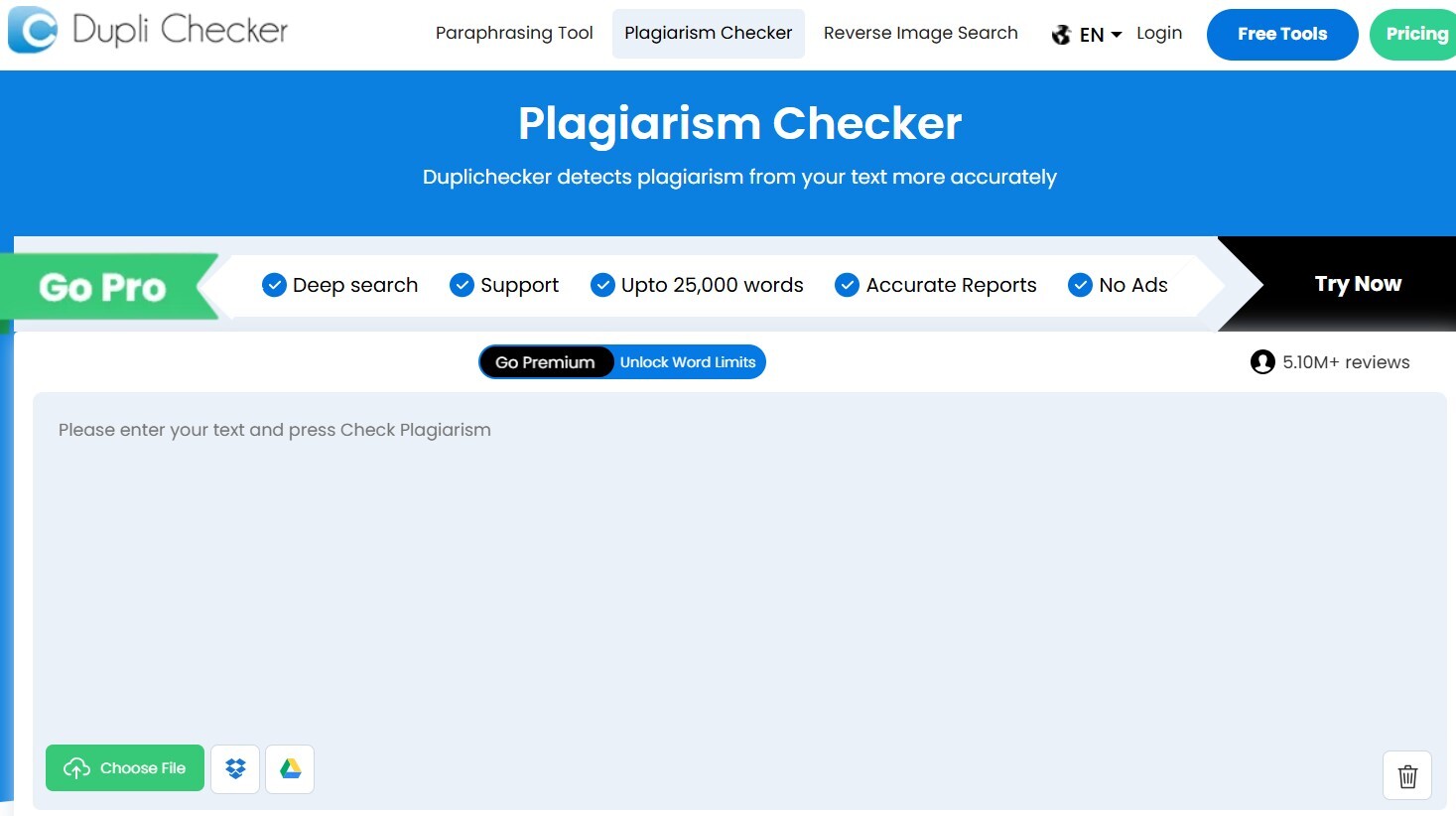
DupliChecker is an online tool that lets anyone check their work for plagiarism. In addition to scanning for copied content, DupliChecker also highlights writing that has been paraphrased from existing sources. A reverse image search enables users to detect fake, stolen, or duplicated images used within text, but each image must be uploaded or pasted separately into the image checker tool.
However, DupliChecker’s interface includes numerous ads that can make the site appear “buggy” or unreliable. A quick Google search shows that users experience problems with the plagiarism checker failing to identify all instances of plagiarism. Some reviewers say the tool isn’t as accurate when checking shorter snippets of text, so quotes or phrases copied without citation may be missed.
Pricing
- Free: Test the plagiarism checker on up to 1,000 words of content
- Paid: Available in weekly, monthly, and yearly options on a complex sliding scale
Top Features
- Built-in grammar check: DupliChecker features a tool that checks grammar in your submitted text, which can be a helpful free alternative to more expensive tools like Grammarly.
- Free option: DupliChecker can be free forever if you only need to check short pieces of content — or you don’t mind breaking larger pieces into chunks for review.
- Unlimited uses: You can use the platform as often as you want and check as much content as you need — but only 1,000 words at a time.
Use Cases:
- Short on time: DupliChecker is a good tool for low-stakes plagiarism checks of content or websites, especially if you’re on a tight deadline.
- Brief, one-off checks: While not an option for checking large amounts of content or multiple web pages at once, DupliChecker can be a good option for students who need to scan short submissions or papers.
- Flexibility: The simple interface lets you copy and paste your content, upload various file types, or enter a website URL for a quick scan.
Winston AI
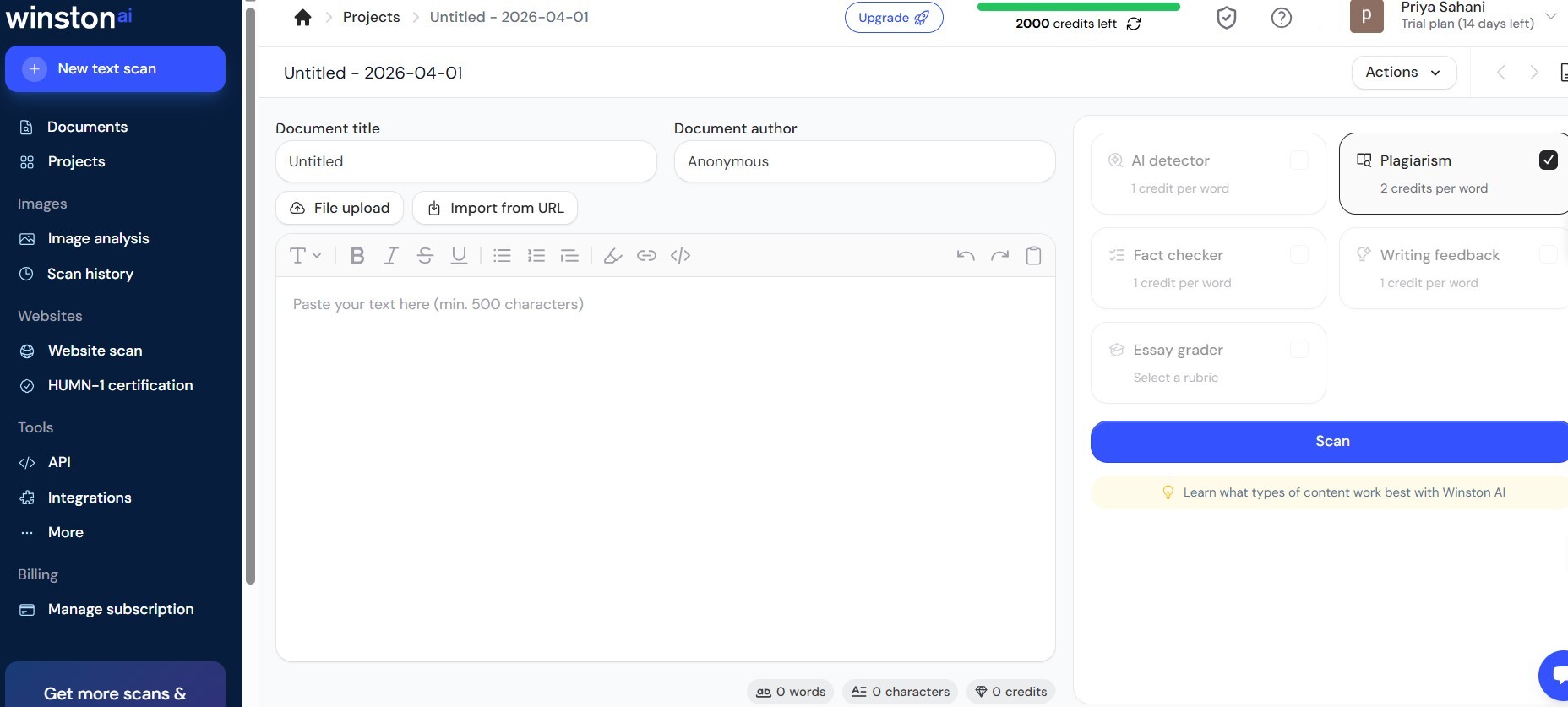
Educators, writers, and SEO teams looking for an accurate Turnitin alternative can try Winston AI’s artificial intelligence detector and plagiarism checker. The company claims it checks against "all known language models," including those that power advanced AI tools. According to the website, Winston AI trains its tools on both human-written and AI-generated data sets and combines the training with algorithms to deliver accurate results.
Pricing
Winston AI’s credit system uses one credit/word for AI detection, two credits/word for plagiarism checks, and 300 credits/image for AI image detection.
- Free: 14-day trial for up to 2,000 credits
- Essential: $12/month annually or $18/month monthly for up to 80,000 credits
- Advanced: $19/month annually or $29/month monthly for up to 500,000 credits
- Elite: $32/month annually or $49/month monthly for up to 500,000 credits
- Businesses and institutions: Custom quotes available on request
Top Features
- Multi-document and image support: Winston AI can check text pasted into its interface or scan a variety of document formats, including document files, PDFs, and images. It's also capable of detecting AI-generated images like deepfakes.
- AI prediction map: Winston AI flags content containing patterns common in AI writing so you can edit it to avoid false positives.
- Readability and grade level scores: Winston AI provides a Flesch-Kinkade report showing readability and grade level for each document. This can help content marketers and freelance writers improve the accessibility of their published content.
Use Cases:
- Content marketing: Content managers can use Winston AI’s tools to ensure their work is human-written, easy to read, and conformed to internal editorial guidelines. The AI detector is also useful for monitoring originality among writers on the content team and identifying contributors who repeatedly violate a company’s content standards.
- Education: Institutions receive unlimited seats with paid plans, so all educators can use Winston AI to detect plagiarism and flag work generated with artificial intelligence tools.
- Freelance writers: Writers can run their work through Winston AI to check readability, detect content that could trigger other AI detectors, and download a detailed report proving the originality of their writing. This option is also useful for students who want to polish their papers prior to submission.
Viper
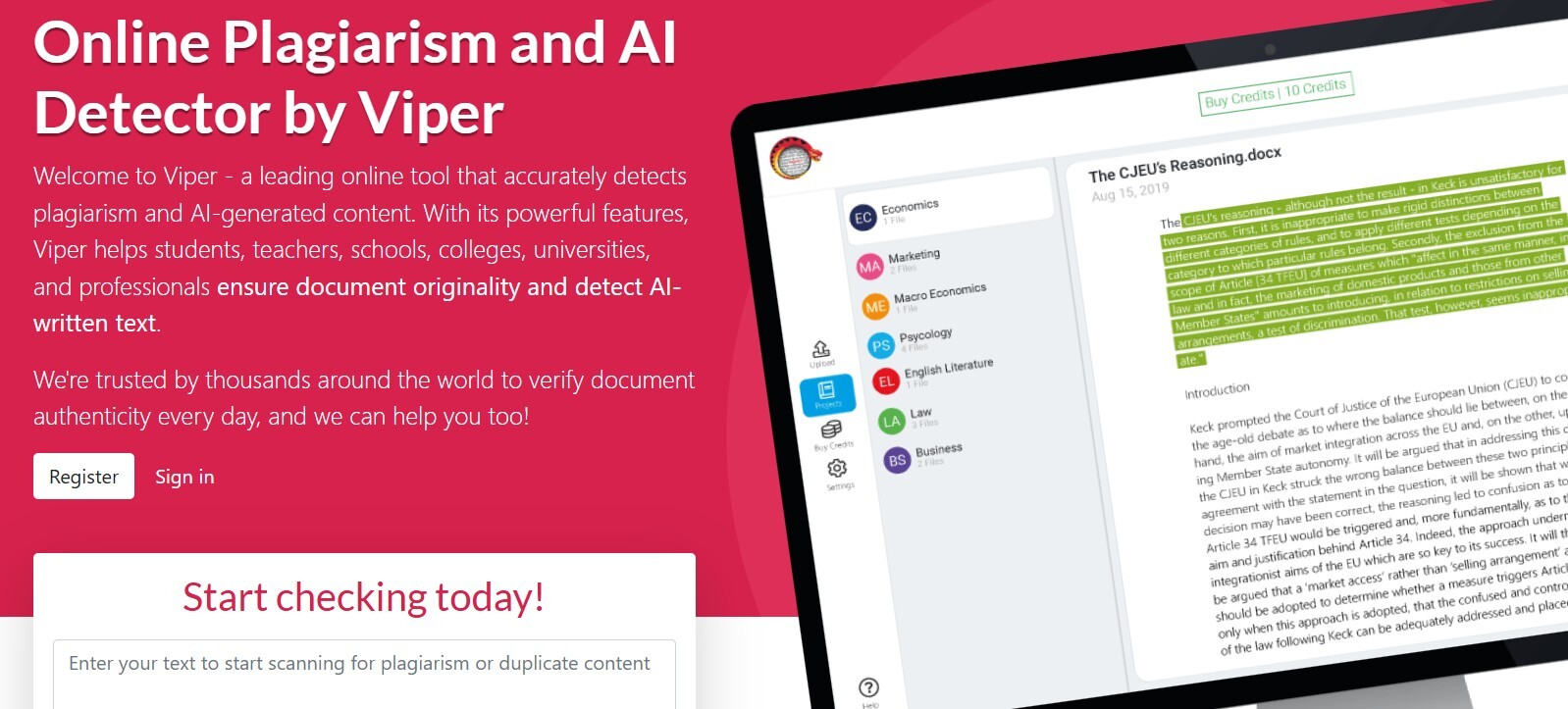
Viper is a plagiarism checker available on scanmyessay.com. Students, educators, and writers can use the free version or purchase credits to evaluate their work. Each Viper scan returns a report showing matches between submitted content and the tool’s database of over 10 billion sources. For institutions, Viper offers the option of uploading personal or private resources so educators can check students’ work for signs of cheating or collusion.
Viper’s free version may seem attractive, but take note: Viper’s terms of service allow the company to add your submitted work to its database and publish it on one of their affiliated “study sites” in the months following your scan. To ensure this doesn’t happen, you’ll need to contact Viper for premium pricing information.
Pricing
- Per credit: Starting at $7.62 for one credit (up to 5,000 words)
- Institution and Professional: Custom quotes are available for groups that need more than 50 credits
Top Features
- Speed: According to the Viper site, a premium scan can be as fast as 30 seconds.
- Flexibility: Viper’s credit-based pricing system allows you to purchase premium scans as needed or in bulk.
- Versatile file support and reporting: Viper allows you to copy and paste content or upload files like Word documents, PDFs, and Google Docs and provides a downloadable plagiarism report for your review.
Use Cases:
- Multilingual content: Viper can help with content production in multiple languages, which allows companies and content teams to cater to international audiences while avoiding plagiarism.
- One-off articles: Buying credits may be preferable to a monthly subscription if you don’t need to check a lot of content.
- Student papers: Students can use Viper as a free plagiarism checker if they don’t mind their content being republished. Professional copywriters, however, may prefer a premium plan or an alternative option to prevent their content from being promoted as a “student paper” on other sites.
Plagiarism Checker X
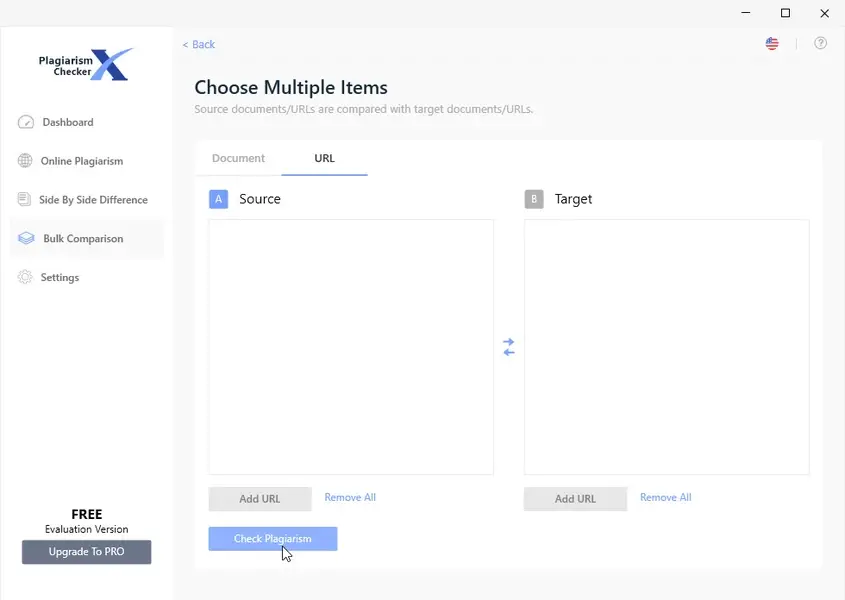
Despite its mysterious name, Plagiarism Checker X is pretty straightforward. It's a Windows application designed only to detect plagiarized content — nothing more. By cross-checking documents with indexed pages across multiple search engines, Plagiarism Checker X can identify similar content from over 16 billion sources.
Pricing
- Basic: Free forever for a limited number of words (limit not specified)
- Premium: One-time payment of $39.95 for unlimited plagiarism checks
- Business: One-time payment of $147.95 for unlimited use (up to 5 users)
Top Features
- Secure desktop app: Unlike online plagiarism detectors, Plagiarism Checker X doesn't require you to upload your work to the internet for scanning. Instead, all scans (and results) stay securely on your personal Windows device.
- Highlighting and reporting: Potentially plagiarized content is highlighted in different colors and tagged with a percent similarity score based on how similar it is to an existing source.
- Flexible scanning and comparison: Plagiarism Checker X can detect plagiarism in a wide range of document types, including Word, PDF, Excel, RTF, and HTML. You can check a single document or compare one or more documents to each other to detect similarities across public and private sources.
Use Cases:
- Educators: Teachers and professors can use Plagiarism Checker X to detect deliberate collusion or unintentional plagiarism in student papers.
- Self-plagiarism: With the side-by-side and bulk comparison options, students can check new work to ensure content from their previously published or submitted pieces is cited properly.
- Content audits: Content teams may find Plagiarism Checker X helpful for auditing existing website pages and new content for similarities or duplicates.
Try Quetext's Free Plagiarism Checker
When compared to other Turnitin alternatives, Quetext comes out as a top choice among plagiarism checkers. Flexible pricing makes Quetext's range of features accessible to students, educators, and academic institutions. Its advanced ColorGrade™ and DeepSearch™ technology provide comprehensive insights to help improve students' work and support academic integrity. Plus, the built-in citation generator makes it easy to spot and correct missing citations without additional software.
Unlike Turnitin, which is accessible only to institutions, Quetext provides quick, efficient plagiarism checking and AI detection with flexible, fair pricing plans—no sales calls necessary. Give Quetext a try (for free!) on your next project, big or small.
FAQ
What is the best plagiarism checker for students?
Is there a free alternative similar to Turnitin?
Which Turnitin alternative has the best AI detector?
What is the most accurate plagiarism checker?
Can students use Turnitin without a school account?
Do plagiarism checkers detect paraphrased content?
However, no tool is perfect. Results should always be reviewed manually to determine whether flagged sections represent legitimate citation issues or acceptable similarity.
Resources

Best Plagiarism Checker APIs in 2026 (Compared for Developers & SaaS Teams)
The plagiarism checker API market in 2026 is split between developer-first platforms (Quetext, Copyleaks) and enterprise-heavy players (Grammarly) with...
Read More
How to Cite ChatGPT and AI-Generated Content in APA, MLA & Chicago Style
All three major style guides (APA, MLA, Chicago) have now published guidance on how to cite ChatGPT and other AI-generated content. If your professor a...
Read More
Paperpal Review 2026: Is It Worth It for Academic Writing? (vs. Quetext)
Paperpal is an AI academic writing assistant built for researchers, graduate students, and journal-submitting authors. It's owned by Cactus Communicati...
Read More